Rolling Down the Elbe
Gwyn and I just returned from a 12-day journey through 1,000 years of history in Germany and Czechia (which they prefer over “Czech Republic”) – and a look at both countries’ Nazi and Communist pasts.
Our Viking cruise took us from Berlin to Prague, along the not-very-mighty Elbe River, through medieval towns, rustic countryside, spectacular cliffs and lands where people have long suffered under tyrants, king and dictators – and produced rebels, reformers and resisters.
We walked along the ruins of the Berlin Wall, which ran nearly 100 miles, encircling West Berlin and imprisoning the people of East Berlin.
When President Kennedy gave his “Ich bin ein Berliner” speech in June 1963, he said, “Freedom has many difficulties and democracy is not perfect, but we have never had to put a wall up to keep our people in.”
In June 1987, at the Brandenburg Gate, President Reagan declared, “Mr. Gorbachev, open this gate! Mr. Gorbachev, tear down this wall!”
Yes, there was a time when American Presidents stood tall and commanded respect in Europe.
History and Horror
The Elbe River is modest – narrow and shallow. If our boat had run aground, we could have waded about 50 yards to either bank.
But it traces world-shaking history.
Spanning it in Potsdam is the Bridge of Spies where Americans and Soviets exchanged prisoners, including downed U2 pilot Frances Gary Powers for Soviet agent Rudolf Abel.
The Tudor-style Cecilienhof Palace hosted the July-August 1945 Potsdam Conference where the Big Three – Truman, Churchill and Stalin – divided Europe into occupation zones.
Nearby is Wannsee Lake, where in 1942 Nazi officials organized the “Final Solution to the Jewish Question” that led to the extermination of six million men, women and children.
Anti-Semitism has a long history in this part of the world.
A stubborn priest named Martin Luther touched off the Reformation in 1517 in Wittenberg, our next stop. Luther is acclaimed for his Ninety-Five Theses challenging Church corruption, his translation of the Bible and many hymns and other writings.
But he also wrote On the Jews and Their Lies, calling for the expulsion of Jews and the burning of synagogues. Nazis quoted him approvingly.
In Prague several days later, we learned that in the 13th Century Jewish residents were forced into the Jewish Ghetto. That made it easy for Nazis to round up their descendants 700 years later.
We stopped in Torgau, site of the (staged) handshake photos of Elbe Day, April 25, 1945, when Soviet and American troops met. The Soviet soldiers were part of a Ukrainian front-line unit that had battled, battered and beaten back the Wehrmacht for many months.
Today, Ukrainian soldiers are still fighting for freedom. Let’s keep extending our hands to them.
The Bombs of Dresden
The beautiful medieval city of Dresden has been rebuilt from the ashes of the firestorm ignited by four waves of brutally effective Allied bombing raids February 13-15, 1945.
But the debate burns on today: Was that a war crime or war-time necessity?
We sailed into Dresden at night, giving us a spectacular view of the brilliantly lit museums, churches and civic buildings – all made from the same local sandstone used in the original structures, a material easily set afire by the incendiary bombs that more than 1,000 planes dropped on the city.
Explosions and a hurricane-like firestorm destroyed the city center. Some 25,000 civilians died. An American POW who was held there, Kurt Vonnegut, later wrote the novel Slaughterhouse Five. He wrote that the bombing was “much worse…than Hiroshima.”
Stalin had pressed the British and Americans to bomb the city and disrupt its rail and road connections. The British Bomber commander, General Arthur Harris, vigorously advocated the bombing of cities. Winston Churchill went along and, despite misgivings, so did American air commanders.
Days after the raids, an AP correspondent used the term “terror bombings” in a dispatch that slipped past censors. Soon, debate erupted in Parliament over the morality of the bombings. The controversy has never ceased.
You can condemn the attacks. But war has its own awful logic. How should we judge those who were eager to end six years of a war that left millions of people dead, a continent in ruins and corpses stacked up in concentration camps?
As a Dresden resident once said, pointing to a swastika flag, “A fire went out from Germany and went around the world in a great arc and came back to Germany.”
You can start a war, but you cannot know how it will end.
The Spires of Prague
Our trip ended in this capital of Czechia, which has been its own nation since it split from Slovakia in 1993.
You can walk Prague’s hilly, winding streets to a multitude of churches, synagogues, museums and concert halls. Cafes, restaurants and beer halls line the streets.
Czechs take pride that they drink more beer per capita than any other people in the world. It’s good, plentiful and cheaper than bottled water. We figured, when in Prague…, so we partook of both the Pilsner and dark beer.
As in Germany, we ate our way through the typical fare of bread, sausages, potatoes and – best of all – a prize meat loaf sandwich. We also were surprised to discover and sample one of the popular Vietnamese restaurants established by immigrants from North Vietnam.
We walked the historic Charles Bridge that dates to 1357 and is named for Charles IV. In the 1300s, he achieved the Triple Crown: King of Bohemia, King of Germany and Holy Roman Emperor.
We traced the steps of the 1968 Velvet Revolution, which was suppressed by Soviet tanks, and the 1989 fall of the Soviet empire. We flew home from Vaclav Havel Airport, named for the author, playwright and imprisoned dissident who became President of Czechoslovakia and later the Czech Republic.
On a commanding hillside overlooking the city once stood the largest statue of Stalin in the world. It was blown up in 1962 and replaced by a large pendulum-like sculpture, a reminder that dictators, kings and empires rise and fall.
Ghosts of the Past
All of our time in Germany was spent in the former East Germany. Like the Czechs, those Germans lived through 12 years of Nazi terror and more than 40 years of communist tyranny.
We learned that some people who grew up under communism then are the most fervent supporters of far-right parties now.
Several of our guides talked frankly about struggling with what happened in those dark decades – and with what their parents and grandparents did or didn’t do.
We in America asked our parents and grandparents, with pride, “What did you do in the war?”
Today’s Germans and Czechs must ask of theirs: Did you go along? Did you support the powers-that-were? Or did you resist?
Our journey down the river reminded us that the tides of history bring every age and every generation its own challenges.
What will future generations ask of us?
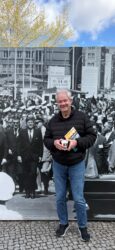
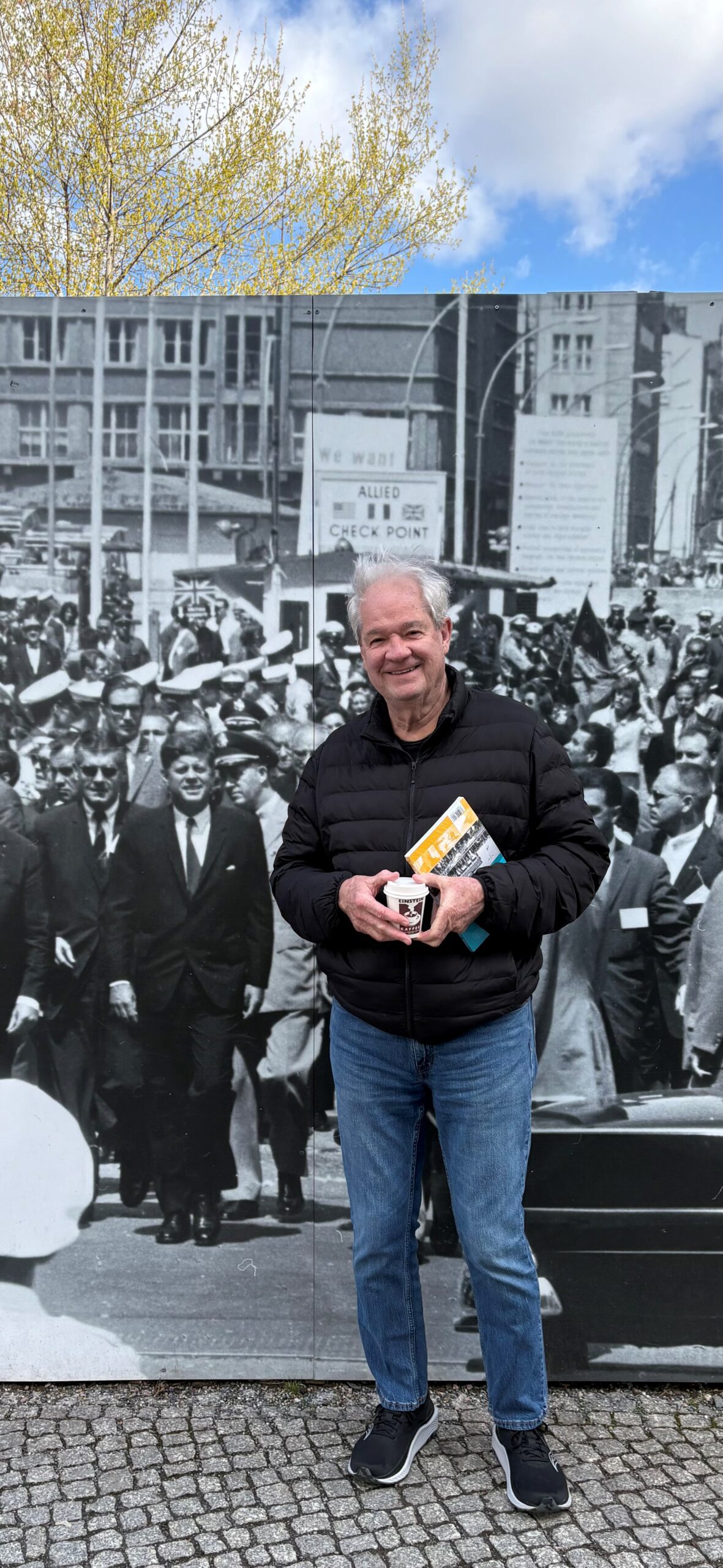
Photo: JFK and me in Berlin.
Rolling Down the Elbe
Gwyn and I just returned from a 12-day journey through 1,000 years of history in Germany and Czechia (which they prefer over “Czech Republic”) – and a look at both countries’ Nazi and Communist pasts.
Our Viking cruise took us from Berlin to Prague, along the not-very-mighty Elbe River, through medieval towns, rustic countryside, spectacular cliffs and lands where people have long suffered under tyrants, king and dictators – and produced rebels, reformers and resisters.
We walked along the ruins of the Berlin Wall, which ran nearly 100 miles, encircling West Berlin and imprisoning the people of East Berlin.
When President Kennedy gave his “Ich bin ein Berliner” speech in June 1963, he said, “Freedom has many difficulties and democracy is not perfect, but we have never had to put a wall up to keep our people in.”
In June 1987, at the Brandenburg Gate, President Reagan declared, “Mr. Gorbachev, open this gate! Mr. Gorbachev, tear down this wall!”
Yes, there was a time when American Presidents stood tall and commanded respect in Europe.
History and Horror
The Elbe River is modest – narrow and shallow. If our boat had run aground, we could have waded about 50 yards to either bank.
But it traces world-shaking history.
Spanning it in Potsdam is the Bridge of Spies where Americans and Soviets exchanged prisoners, including downed U2 pilot Frances Gary Powers for Soviet agent Rudolf Abel.
The Tudor-style Cecilienhof Palace hosted the July-August 1945 Potsdam Conference where the Big Three – Truman, Churchill and Stalin – divided Europe into occupation zones.
Nearby is Wannsee Lake, where in 1942 Nazi officials organized the “Final Solution to the Jewish Question” that led to the extermination of six million men, women and children.
Anti-Semitism has a long history in this part of the world.
A stubborn priest named Martin Luther touched off the Reformation in 1517 in Wittenberg, our next stop. Luther is acclaimed for his Ninety-Five Theses challenging Church corruption, his translation of the Bible and many hymns and other writings.
But he also wrote On the Jews and Their Lies, calling for the expulsion of Jews and the burning of synagogues. Nazis quoted him approvingly.
In Prague several days later, we learned that in the 13th Century Jewish residents were forced into the Jewish Ghetto. That made it easy for Nazis to round up their descendants 700 years later.
We stopped in Torgau, site of the (staged) handshake photos of Elbe Day, April 25, 1945, when Soviet and American troops met. The Soviet soldiers were part of a Ukrainian front-line unit that had battled, battered and beaten back the Wehrmacht for many months.
Today, Ukrainian soldiers are still fighting for freedom. Let’s keep extending our hands to them.
The Bombs of Dresden
The beautiful medieval city of Dresden has been rebuilt from the ashes of the firestorm ignited by four waves of brutally effective Allied bombing raids February 13-15, 1945.
But the debate burns on today: Was that a war crime or war-time necessity?
We sailed into Dresden at night, giving us a spectacular view of the brilliantly lit museums, churches and civic buildings – all made from the same local sandstone used in the original structures, a material easily set afire by the incendiary bombs that more than 1,000 planes dropped on the city.
Explosions and a hurricane-like firestorm destroyed the city center. Some 25,000 civilians died. An American POW who was held there, Kurt Vonnegut, later wrote the novel Slaughterhouse Five. He wrote that the bombing was “much worse…than Hiroshima.”
Stalin had pressed the British and Americans to bomb the city and disrupt its rail and road connections. The British Bomber commander, General Arthur Harris, vigorously advocated the bombing of cities. Winston Churchill went along and, despite misgivings, so did American air commanders.
Days after the raids, an AP correspondent used the term “terror bombings” in a dispatch that slipped past censors. Soon, debate erupted in Parliament over the morality of the bombings. The controversy has never ceased.
You can condemn the attacks. But war has its own awful logic. How should we judge those who were eager to end six years of a war that left millions of people dead, a continent in ruins and corpses stacked up in concentration camps?
As a Dresden resident once said, pointing to a swastika flag, “A fire went out from Germany and went around the world in a great arc and came back to Germany.”
You can start a war, but you cannot know how it will end.
The Spires of Prague
Our trip ended in this capital of Czechia, which has been its own nation since it split from Slovakia in 1993.
You can walk Prague’s hilly, winding streets to a multitude of churches, synagogues, museums and concert halls. Cafes, restaurants and beer halls line the streets.
Czechs take pride that they drink more beer per capita than any other people in the world. It’s good, plentiful and cheaper than bottled water. We figured, when in Prague…, so we partook of both the Pilsner and dark beer.
As in Germany, we ate our way through the typical fare of bread, sausages, potatoes and – best of all – a prize meat loaf sandwich. We also were surprised to discover and sample one of the popular Vietnamese restaurants established by immigrants from North Vietnam.
We walked the historic Charles Bridge that dates to 1357 and is named for Charles IV. In the 1300s, he achieved the Triple Crown: King of Bohemia, King of Germany and Holy Roman Emperor.
We traced the steps of the 1968 Velvet Revolution, which was suppressed by Soviet tanks, and the 1989 fall of the Soviet empire. We flew home from Vaclav Havel Airport, named for the author, playwright and imprisoned dissident who became President of Czechoslovakia and later the Czech Republic.
On a commanding hillside overlooking the city once stood the largest statue of Stalin in the world. It was blown up in 1962 and replaced by a large pendulum-like sculpture, a reminder that dictators, kings and empires rise and fall.
Ghosts of the Past
All of our time in Germany was spent in the former East Germany. Like the Czechs, those Germans lived through 12 years of Nazi terror and more than 40 years of communist tyranny.
We learned that some people who grew up under communism then are the most fervent supporters of far-right parties now.
Several of our guides talked frankly about struggling with what happened in those dark decades – and with what their parents and grandparents did or didn’t do.
We in America asked our parents and grandparents, with pride, “What did you do in the war?”
Today’s Germans and Czechs must ask of theirs: Did you go along? Did you support the powers-that-were? Or did you resist?
Our journey down the river reminded us that the tides of history bring every age and every generation its own challenges.
What will future generations ask of us?
Photo: JFK and me in Berlin.