A Writer’s Mark
My wife didn’t say I had to go, but I figured it was smart to go.
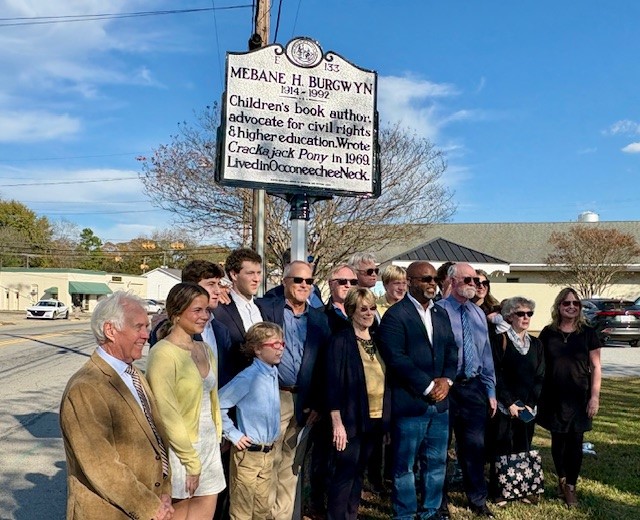
So, instead of walking our dog in the woods and watching football last Saturday, I went with her to Northampton County for the unveiling of a state historical marker honoring her late aunt, Mebane Holoman Burgwyn.
The Burgwyn family – hence my wife’s name, Gwyn – has long been active in the northeastern North Carolina county – leaders in farming, business, the law and politics.
Her grandfather, W.H.S. Burgwyn, was a state senator and a judge. Her uncle Bill was the long-time district attorney.
Good Democrats.
Like me, Mebane married into the family. She was a writer, the author of seven books for young adults, including Crackajack Pony, which won the American Association of University Women’s Award for best juvenile book of 1970.
I did my homework last week, reading her first book, River Treasure, published in 1948.
Rep. Rodney Pierce, who represents Northampton in the state House and presided over the marker’s unveiling, said that when the Burgwyn family approached him about a historical marker, he first thought: “Oh, no. Every family thinks they have a relative who deserves a marker.”
But the more he learned, Pierce said he realized, “We’ve got something here” – enough to meet the state’s strict standards for markers.
He noted the “courage” it took at that time for her to write with empathy about Black families living in the Occoneechee Neck area of the county, along the flood-prone Roanoke River.
Along with writing her books, Mebane was a school guidance counselor, a creative-writing teacher, a member of the UNC Board of Trustees from 1955-1971 and an East Carolina University trustee from 1973-1981.
She and her husband John raised four rambunctious children on a farm in Occoneechee Neck. They hosted a luncheon there for Gwyn and me on our wedding day.
My late colleague from The News & Observer, Roy Parker Jr., wrote this about her after she died in 1992:
“Her books for young people were written intelligently, elegantly, without the sweet edge of much previous juvenile fiction. Even more startling, the stories were about Black children. Mebane found her young heroes right there in Occoneechee Neck.”
He added, “She pioneered so many important things for North Carolina – writing good fiction for teenagers; fighting for better schools, especially for Black children; offering wise counsel as one of the architects of restructuring that created the University of North Carolina System.”
He quoted long-time UNC President Bill Friday, who said of Mebane: “She had a high degree of social consciousness. Her life and work had a lyrical quality.”
Mebane’s marker is on U.S. 158 in the town of Jackson.
Fittingly, it stands in front of the county library.
Photo: Rep. Rodney Pierce with members of Mebane Holoman Burgwyn’s family.

A Writer’s Mark
My wife didn’t say I had to go, but I figured it was smart to go.
So, instead of walking our dog in the woods and watching football last Saturday, I went with her to Northampton County for the unveiling of a state historical marker honoring her late aunt, Mebane Holoman Burgwyn.
The Burgwyn family – hence my wife’s name, Gwyn – has long been active in the northeastern North Carolina county – leaders in farming, business, the law and politics.
Her grandfather, W.H.S. Burgwyn, was a state senator and a judge. Her uncle Bill was the long-time district attorney.
Good Democrats.
Like me, Mebane married into the family. She was a writer, the author of seven books for young adults, including Crackajack Pony, which won the American Association of University Women’s Award for best juvenile book of 1970.
I did my homework last week, reading her first book, River Treasure, published in 1948.
Rep. Rodney Pierce, who represents Northampton in the state House and presided over the marker’s unveiling, said that when the Burgwyn family approached him about a historical marker, he first thought: “Oh, no. Every family thinks they have a relative who deserves a marker.”
But the more he learned, Pierce said he realized, “We’ve got something here” – enough to meet the state’s strict standards for markers.
He noted the “courage” it took at that time for her to write with empathy about Black families living in the Occoneechee Neck area of the county, along the flood-prone Roanoke River.
Along with writing her books, Mebane was a school guidance counselor, a creative-writing teacher, a member of the UNC Board of Trustees from 1955-1971 and an East Carolina University trustee from 1973-1981.
She and her husband John raised four rambunctious children on a farm in Occoneechee Neck. They hosted a luncheon there for Gwyn and me on our wedding day.
My late colleague from The News & Observer, Roy Parker Jr., wrote this about her after she died in 1992:
“Her books for young people were written intelligently, elegantly, without the sweet edge of much previous juvenile fiction. Even more startling, the stories were about Black children. Mebane found her young heroes right there in Occoneechee Neck.”
He added, “She pioneered so many important things for North Carolina – writing good fiction for teenagers; fighting for better schools, especially for Black children; offering wise counsel as one of the architects of restructuring that created the University of North Carolina System.”
He quoted long-time UNC President Bill Friday, who said of Mebane: “She had a high degree of social consciousness. Her life and work had a lyrical quality.”
Mebane’s marker is on U.S. 158 in the town of Jackson.
Fittingly, it stands in front of the county library.
Photo: Rep. Rodney Pierce with members of Mebane Holoman Burgwyn’s family.