Resist. Read.
“There is a reason that fascists burn books. They are afraid of critical thinking. They are afraid of thought. What you have learned here at Wesleyan is how to read…. Reading is the most subversive thing you can do.”
That bright ray broke through the clouds of commencement-speech cliches.
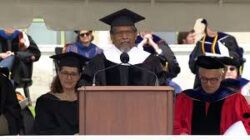
It’s from the writer Percival Everett’s speech at Wesleyan University in Connecticut (photo).
Everett is author of James, an extraordinary retelling of Adventures of Huckleberry Finn which reimagines the relationship between Huck and the runaway slave Jim. The book won the 2025 Pulitzer Prize for Fiction.
Everett said in his speech, “People stand up on these occasions and talk about the hope that graduates like yourselves represent. You will hear that you are the promise for our culture, that you are our future. This is all true, cliché of course, but no less true for that fact. Given the state of our country, you are more than a mere promise. You might well be the last line of defense of and for American intellectual life.
“There are those among us who would not rewrite history, but erase it, who would not challenge science with science, but replace it with fear and opinion, who would not champion charity and generosity for any reason except profit and/or public perception. These are not our enemies, and we should not give them power by seeing them as such. They are a disease in our world, one that will be cured by education and by intellectual standards taught and maintained in places such as this.
“We are faced with forces that would limit our educations, that would curtail our ability to discuss and examine and dismantle ideas without fear. These forces are opposed to intellectual pursuits, opposed to challenges to the status quo. They would monetize everything if they could. They are afraid of you, all of you. There is a reason that fascists burn books. They are afraid of critical thinking. They are afraid of thought. What you have learned here at Wesleyan is how to read. That is no small thing. Your reading is not confined to the page. You have learned to read the world, people, actions, conspiracies. You have learned to think for yourselves.
“Reading is the most subversive thing you can do. When you read, no one knows what’s going into you, even if they are reading over your shoulder, and they are. The second most subversive thing is not writing; that’s a distant third. The second is belonging to a book club or being in a classroom. None of you have ever been indoctrinated by a good teacher. You have learned to resist indoctrination, you have learned to be critical and properly skeptical. This life of the mind that has been opened to you will make your life richer, will allow you to grow, and, my hope, will allow you to challenge the anti-intellectual elements that have taken root and attempt to use fear to silence those who think. I ask nothing more from you than to do what you have been doing. Go out into the fray and keep reading.”
Resist. Read.

“There is a reason that fascists burn books. They are afraid of critical thinking. They are afraid of thought. What you have learned here at Wesleyan is how to read…. Reading is the most subversive thing you can do.”
That bright ray broke through the clouds of commencement-speech cliches.
It’s from the writer Percival Everett’s speech at Wesleyan University in Connecticut (photo).
Everett is author of James, an extraordinary retelling of Adventures of Huckleberry Finn which reimagines the relationship between Huck and the runaway slave Jim. The book won the 2025 Pulitzer Prize for Fiction.
Everett said in his speech, “People stand up on these occasions and talk about the hope that graduates like yourselves represent. You will hear that you are the promise for our culture, that you are our future. This is all true, cliché of course, but no less true for that fact. Given the state of our country, you are more than a mere promise. You might well be the last line of defense of and for American intellectual life.
“There are those among us who would not rewrite history, but erase it, who would not challenge science with science, but replace it with fear and opinion, who would not champion charity and generosity for any reason except profit and/or public perception. These are not our enemies, and we should not give them power by seeing them as such. They are a disease in our world, one that will be cured by education and by intellectual standards taught and maintained in places such as this.
“We are faced with forces that would limit our educations, that would curtail our ability to discuss and examine and dismantle ideas without fear. These forces are opposed to intellectual pursuits, opposed to challenges to the status quo. They would monetize everything if they could. They are afraid of you, all of you. There is a reason that fascists burn books. They are afraid of critical thinking. They are afraid of thought. What you have learned here at Wesleyan is how to read. That is no small thing. Your reading is not confined to the page. You have learned to read the world, people, actions, conspiracies. You have learned to think for yourselves.
“Reading is the most subversive thing you can do. When you read, no one knows what’s going into you, even if they are reading over your shoulder, and they are. The second most subversive thing is not writing; that’s a distant third. The second is belonging to a book club or being in a classroom. None of you have ever been indoctrinated by a good teacher. You have learned to resist indoctrination, you have learned to be critical and properly skeptical. This life of the mind that has been opened to you will make your life richer, will allow you to grow, and, my hope, will allow you to challenge the anti-intellectual elements that have taken root and attempt to use fear to silence those who think. I ask nothing more from you than to do what you have been doing. Go out into the fray and keep reading.”